Review: Tea on the Terrace
Sheppard, K. (2022) Tea on the Terrace: Hotels and Egyptologists’ Social Networks, 1885-1925. Manchester University Press.
Following is my personal opinion of this book. I too, am someone who has seen the wealthy (or status of particular institutions) continue to get archaeological priority in Egypt, and that women and Egyptians are still fighting for their rights and acknowledgements in the field of Egyptian archaeology. I am an Egyptian archaeologist who has worked and traveled throughout Egypt for the past 25 years. That is my lens.
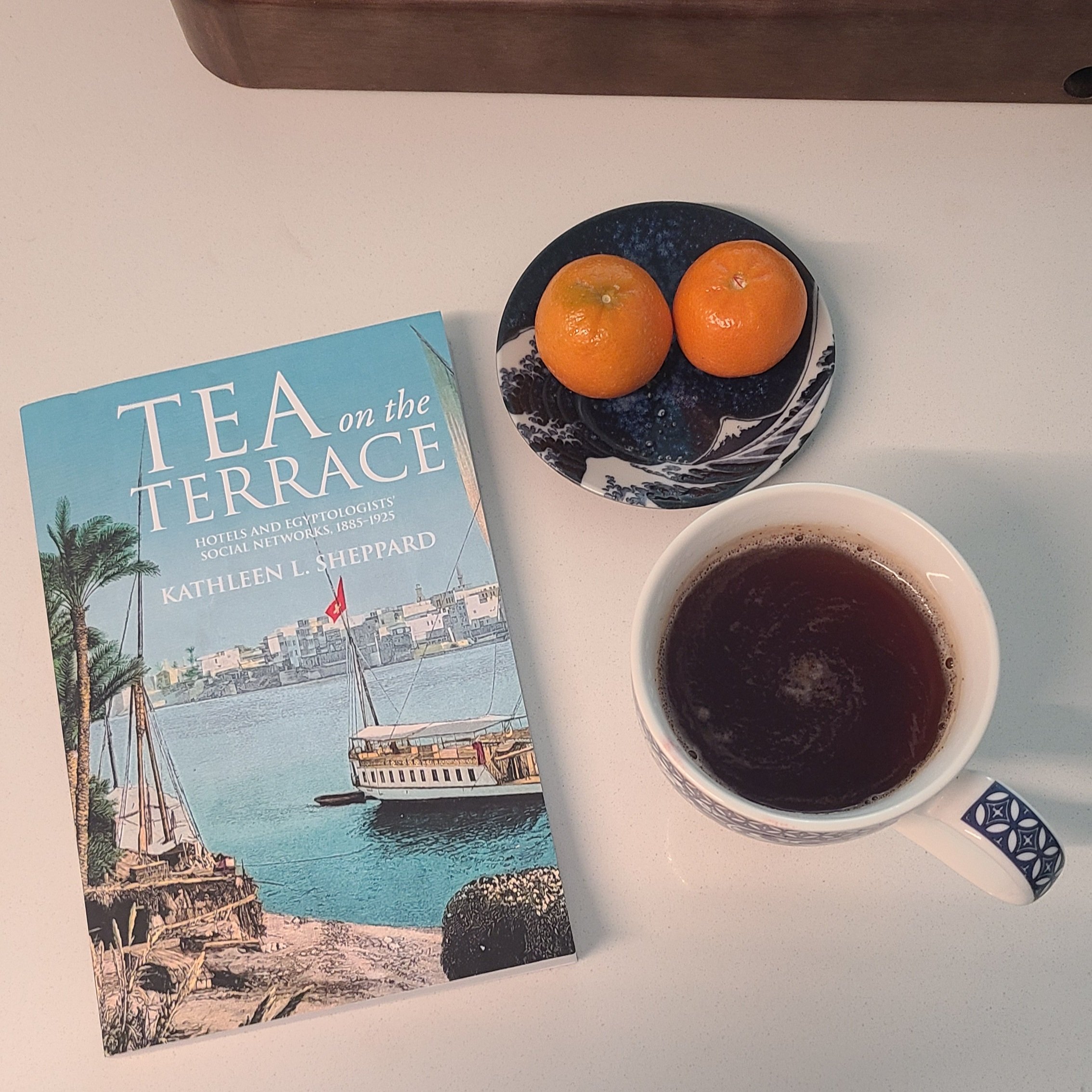
A book about Egypt…
along with Mandarin oranges from China, on a Japanese plate, with a cup of freshly brewed Indian black tea. Pull up a chair and let’s chat!
The author holds the premise that hotels and dahabeahs[1] were ‘truth spots’ for developing social networks and financial backing, as well as refining theories from the archaeological record (purchased items or excavated objects).
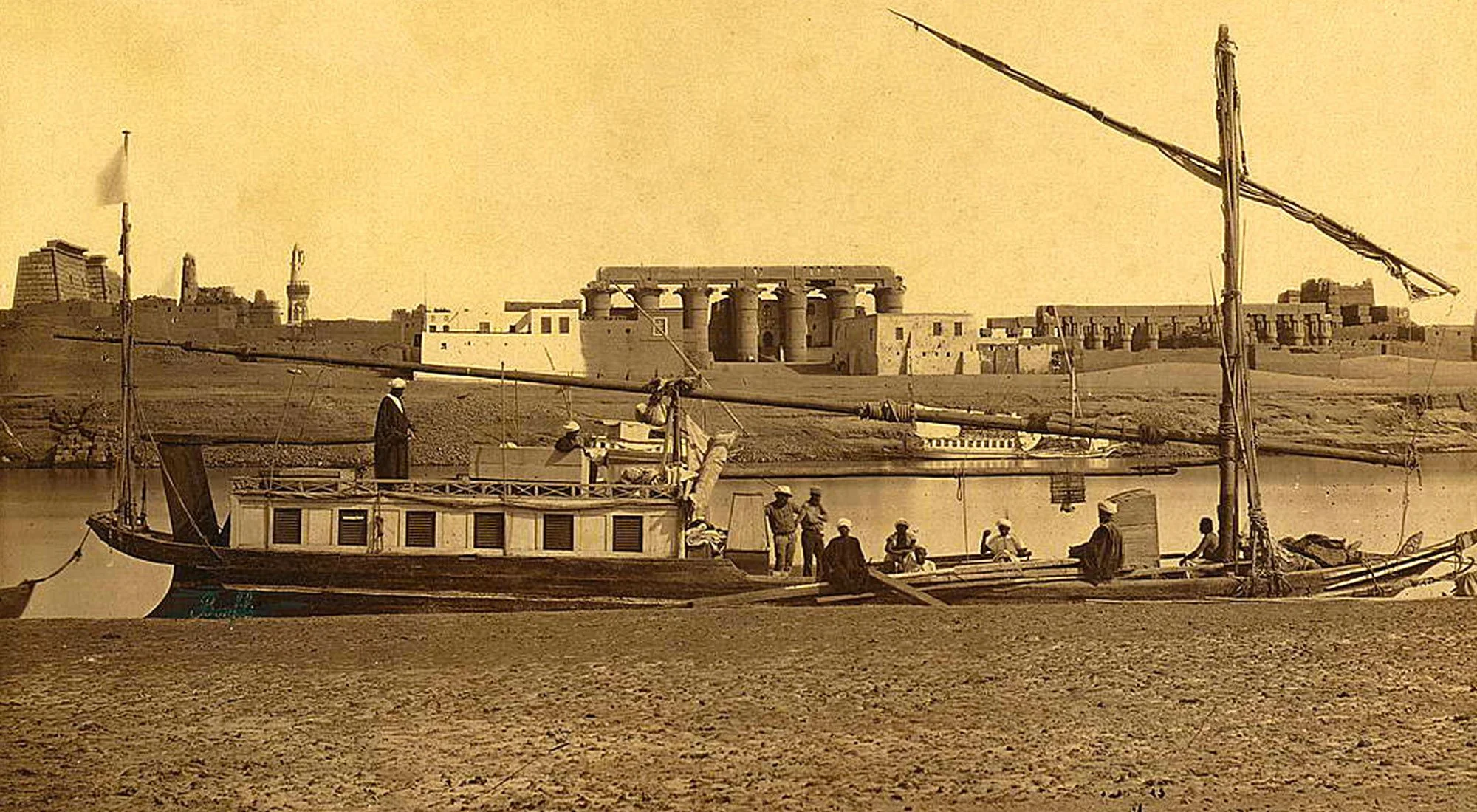
Early 20th century dahabiya
“In the history of archaeology, too, place has power in the production of knowledge. Among archaeologists, the knowledge gained at the trowel’s edge has always held particular importance; scientists developed and refined their theories based on objects coming out of the ground. Recently scholars have highlighted the importance of other locations where archaeological knowledge is created, including the classroom, in which future practitioners are educated in the field, and the museums. in which the general public is exposed to archaeological theory and practice. This book argues that Egyptian hotels represent an important locus for the creation of archaeological knowledge and the networks necessary for that knowledge. ”
While I’m not in disagreement about the fact that the loci (hotels and floating institutions) brought together (certain) people with varying interests (often for personal collecting versus the pursuit of scientific knowledge), I feel the fact that people who could fund these projects (with the hopes of adding to their collections) were most often privileged white men with ulterior motives - and at the exclusion of the Egyptian people. I understand the romantic idea of theory being developed in these ways, but often by people with no academic background, no (scientific) field experience and with the financial power to purchase permits (to steal the heritage from the Egyptian people). I don’t find that fact either scientific, or romantic. I appreciate the historical research presented by the author, but hoped for a more thorough and unbiased view that many of these people were either ‘archaeologists’ or ‘scientists’ is truly debatable.[2] Yes, this book is collated around the late 19th and early 20th centuries, but this romanticizing of ‘archaeology’ and early ‘looters’ of Egypt should be defined as such. This book makes heroes of criminals, like Charles Wilbour (p. 116) who was an American fraudster who stole millions and then used that money to pursue his passion in Egypt (collecting artifacts), and then being congratulated for his estate posthumously donating them to the Brooklyn Museum.
The author uses some reference material that I have also reviewed, including the travelogue A Thousand Miles up the Nile by Amelia Edwards [3] and Cook’s Tourist’s Handbook: Egypt, the Nile and Desert.[4] Check the footnotes for the links if you wish to read my reviews.
I’m not saying the author doesn’t mention the obvious…
“These hotels became important nodes in the cognitive topography of the city, excluding all but the wealthy, the connected, the hopeful, and the male Egyptologists.”
…but it is buried and could have been more explicit - at least in the conclusion.
Don’t get me wrong, there are also many wonderful pieces of information that I found quite interesting in this book. I was unaware of this particular event, following, that describes the Cooks creating signs for tourists to prevent damage to Egyptian croplands…
“...in 1891, Flinders Petrie discovered a beautifully preserved painted floor at Armana. Although, Petrie built a structure over the floor to protect it on site, by 1911, frustrated and angry farmers destroyed the entire floor to keep people away, because tourists kept flocking to the site through their cultivation, destroying crops in the process.”
I enjoy a good illustration, but sometimes adding an illustration for the sake of an illustration is (to me) more annoying. Some of the maps are unreadable as printed. If the author wanted to include them, they should have been larger and printed more clearly. My Two Cents!
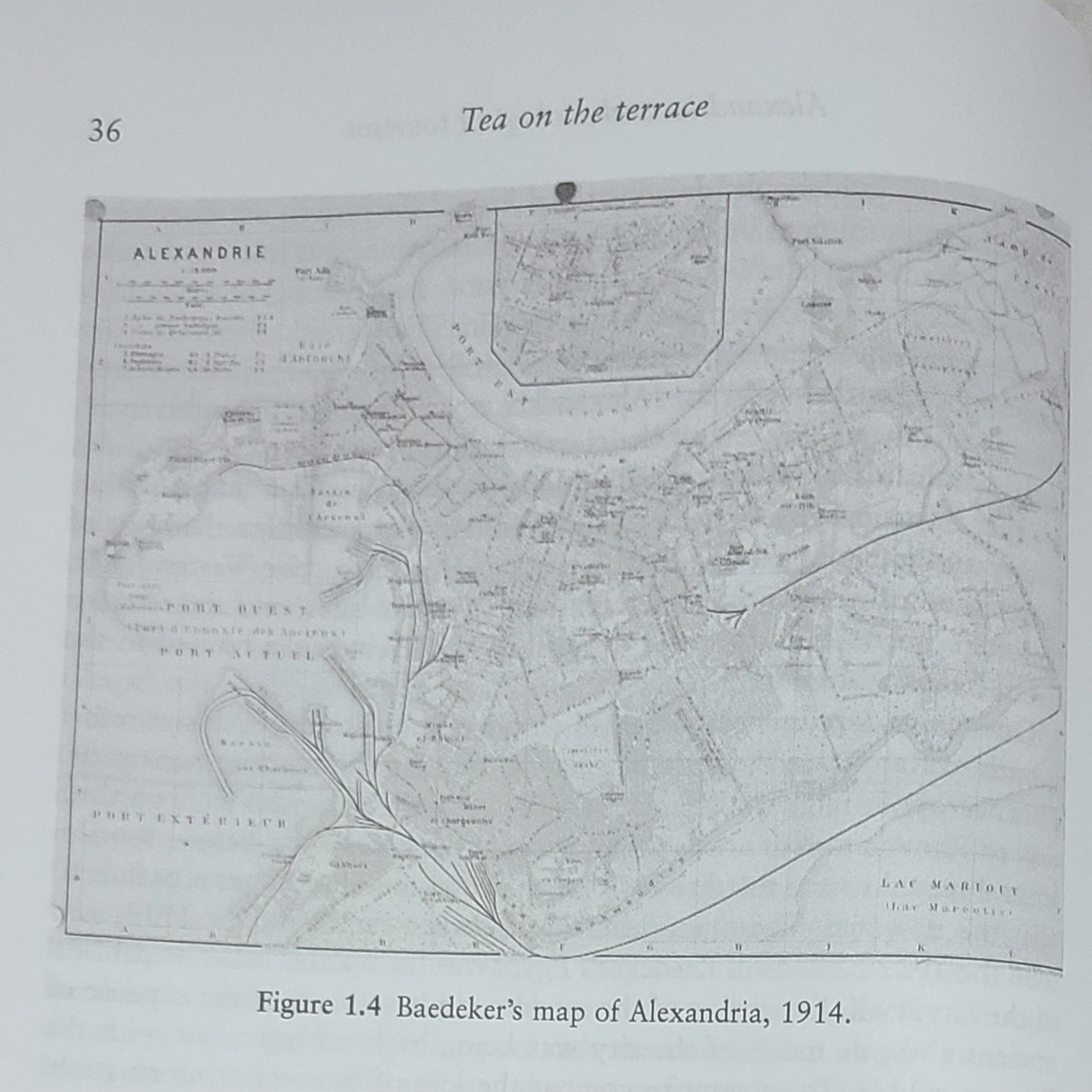
Fig. 1.4 from Sheppard’s book
Half page greyscale illustration (p. 36)
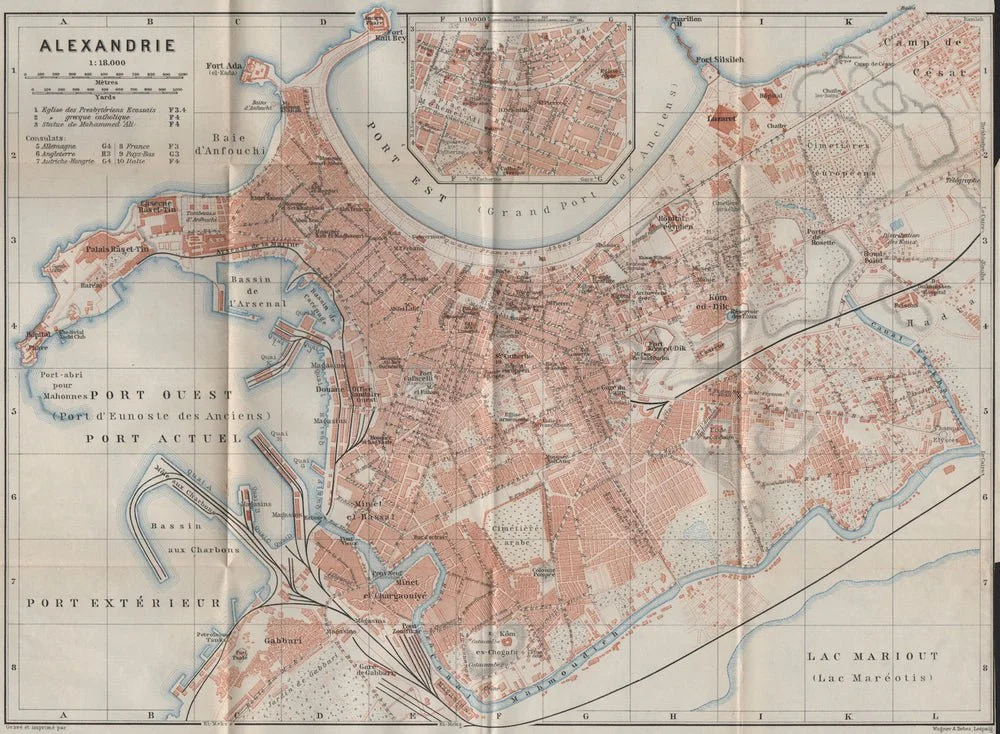
Baedeker, map of Alexandria (1911)
I wished to get some recent pictures of the Winter Palace Hotel in Luxor (mentioned in this book), but alas it is currently closed for renovation to be reopened next summer (July 2027) as the new Mandarin Oriental Winter Palace, under new management.[5] I will try to get there next year to see the changes.
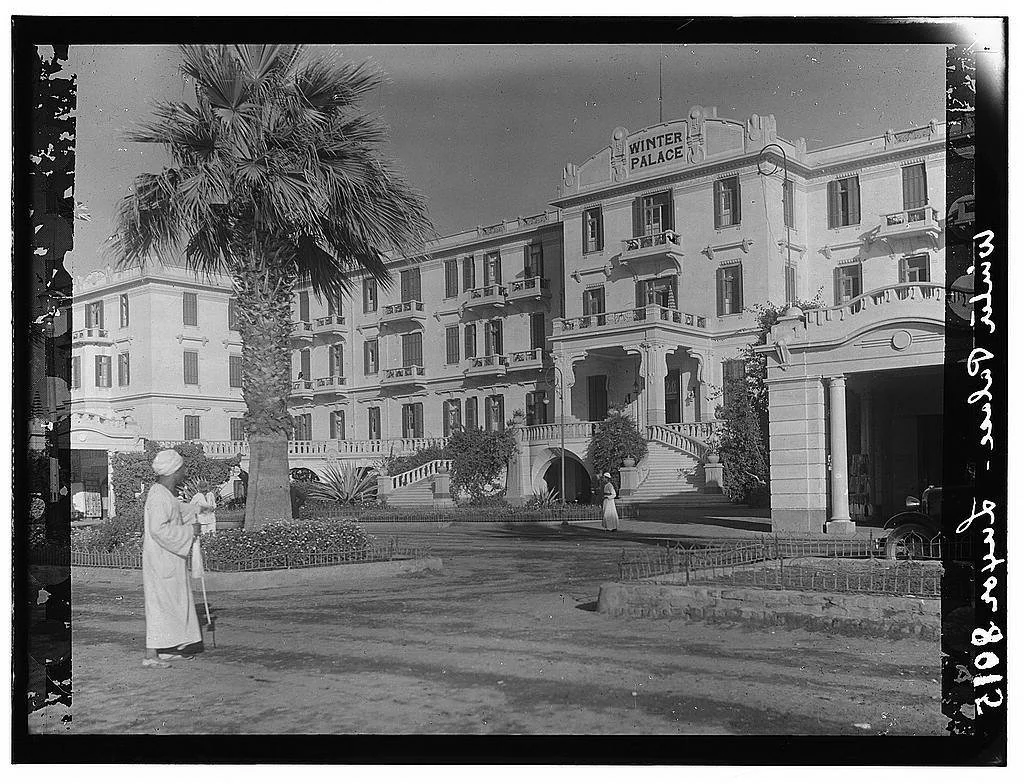
Winter Palace Hotel, Luxor, Egypt; from southwest (01/01/1936)
Public domain image of Egyptian art, free to use, no copyright restrictions photo - Picryl
Yes, I fell for the title. I love tea, and I love Egypt. I should have known better. It is a valid piece of writing and research if taken with a liberal amount of salt and viewed through the lens that I hoped would have been there, rather than expecting the readers to filter it. It felt to me like a book written in the 1950s, not in 2022.
I recommend the book for the historical knowledge presented. I encourage the reader to think critically about the context.
You can see the review I wrote about another of the author’s books, Women in the Valley of the Kings. That book was published two years (2024) after the current one I am discussing. I only realized after I started reading this that it was the same author.
[1] Dahabiya (ذهبية) means the ‘golden one’ and refers to a flat-bottomed, two-masted sailing vessel that plied the waters of the Nile.
[2] See my post Archaeology is a professional job
[3] A Thousand Miles up the Nile - book review
[4]19th century travel in Egypt
[5] History and management information from Wikipedia.