World Rivers Day 2026 - Nile
Celebrated on September 27, 2026, the official theme for World Rivers Day 2026 is, “No Forests, No Rivers, No Water, No Life”. This year I wish to highlight the Nile in Egypt, and some of the tremendous issues this river faces.
“For any one who sees Egypt, without having heard a word about it before, must perceive, if he has only common powers of observation, that the Egypt to which the Greeks go in their ships is an acquired country, the gift of the river. ”
Due to extensive agricultural, residential and urban development along the Nile, there appears to no longer be big stretches of riparian areas covered in trees, except perhaps planted mangoes, bananas and date palms. Egypt has a very narrow strip of land along each side of the Nile that is habitable for both humans and cropland. Outside of that is the Eastern and Sinai Deserts, and the Sahara to the West. With a booming population,[1,2] even cropland has been forsaken for construction of high-rise apartments.[3] During the 25 years I’ve been coming to Egypt, I’ve noticed a huge increase of construction and decreased agriculture land abutting the river. Longer canals and irrigation systems are stretching farther into the desert to accommodate this loss of fertile land.[4]
Along with the High Aswan Dam and the absence of the annual inundation that would bring life-giving silt to the soil, now farmers are relying more and more on industrial fertilizers for their crops.
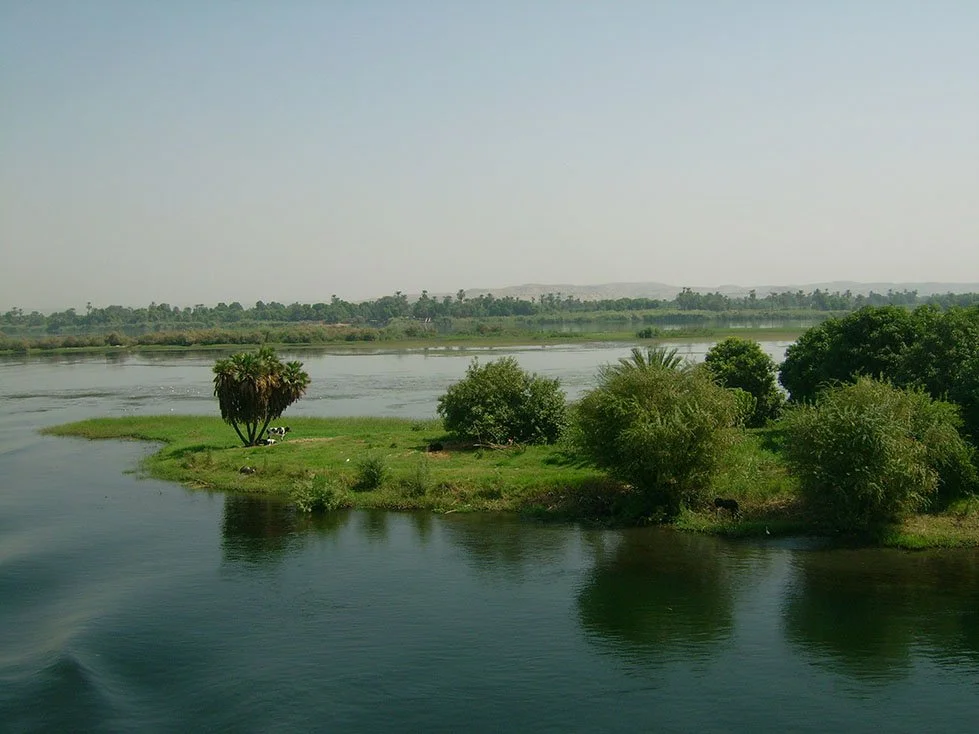
This type of bucolic scene is becoming rarer along the Egyptian stretch of the Nile. Photo taken from a cruise ship, somewhere between Edfou and Kom Ombo (2015).
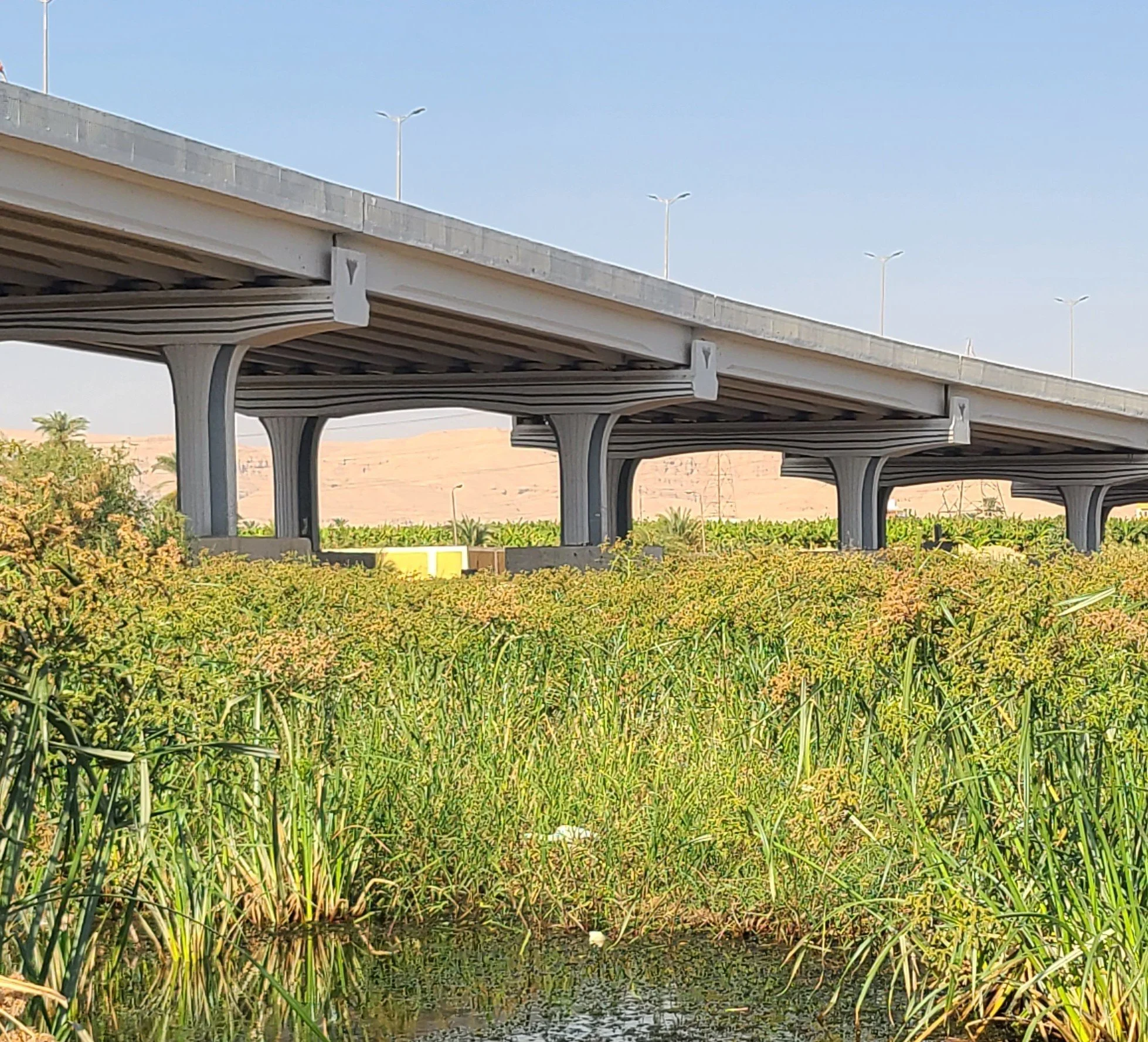
A New Luxor Axis bridge[5] opened in 2024 that connects
Luxor and the West Bank. It is definitely more convenient for access by tourists to the archaeological sites, but has opened other areas near it for more development.
Photo: from beneath the new bridge (2025)
Egypt is dependent on the Nile for >90% of its fresh water,[6] but with a fast-growing population and increased tourism, the infrastructure to deal with waste is seemingly insufficient, and I have witnessed a noticeable increase in pollution in the Nile in Egypt over the years.[7] The government, and many Egyptians, are also very concerned with the construction of the Grand Ethiopian Renaissance Dam (GERD) which was completed and filled in 2025 and would control flow of the Nile downstream (in the Sudan and Egypt).[8]
Water availability is an extremely complex issue for this arid country.
“Egypt, a predominantly arid and hyper-arid country, is one of the environmentally most fragile regions of the world. The country became a hot spot for climatic extremes and aridity change in the global warming context.”
The Nile is the lifeforce of Egypt and is threatened by ‘severe water scarcity’.[10] I hope this World Rivers Day, that Egypt continues to take measures to protect this precious resource.
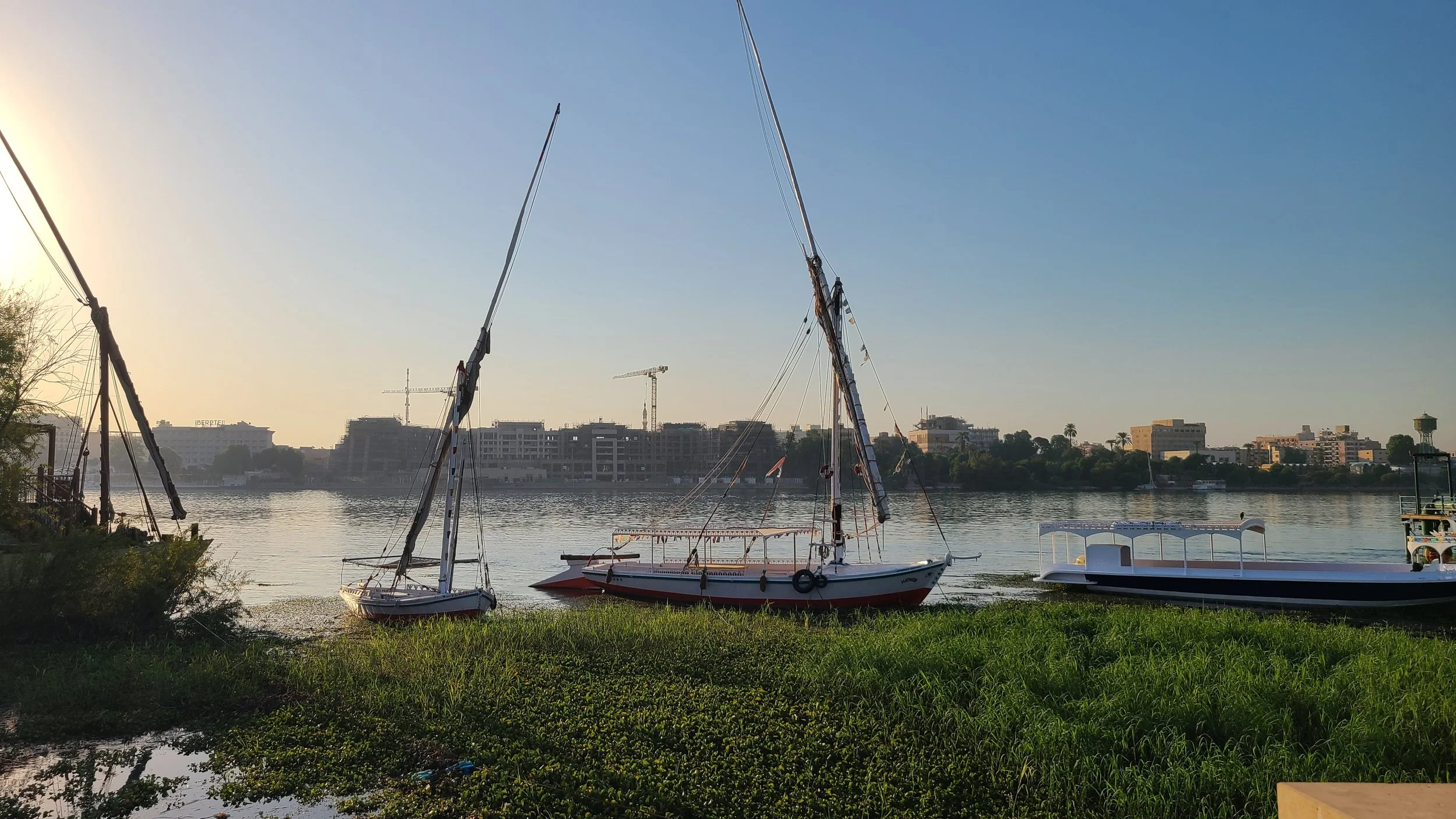
The Nile, from the West Bank, with a view of the expansive new Four Seasons Hotel being constructed along the river in Luxor. (2026)
You can see my previous post World Rivers Day 2024 - which discussed the Orontes, the Yukon and the Bow River.
[1] According to the CAPMAS, in 2015 Egypt had a population of 89.4 million people. Ahram Online (2015) Egypt's population grows by over 3.5 million since 2014: Central Agency for Public Mobilization and Statistics (CAPMAS). Posted online September 3, 2015.
[2] By mid-2026, the population has increased to 120,540,000. Worldometer - Egypt Population - accessed September 1, 2026.
[3] “Urban growth modelling conducted by the World Bank projects an additional 25 124 ha of agricultural land will be lost by 2030 due to continued urban expansion.” OECD (2026) Policies for the Future of Farming and Food in Egypt. Posted online May 4, 2026.
[4] New Delta Project - which will be filled by treated water and a portion of groundwater. Smart Water Magazine (2023) Egypt builds artificial river parallel to Nile River. Posted online July 5, 2023.
[5] Hassam Allam Holding (2024) The North Luxor Axis Road and Bridge Project built by our teams at Hassan Allam Roads and Bridges and 3S Ready Mix. Posted online May 29, 2024.
[6] UN Department of Economic and Social Affairs Sustainable Development (2026) Egypt: Progress on achieving SDG 6 (which aims to ensure the availability and sustainable management of clean water and sanitation for all by 2030). That number increases to over 98% according to the following reference: Egypt State Information Service (2026) Egypt faces water scarcity challenges, relies on Nile for 98% of water resources – Min. Posted online February 10, 2026.
[7] Recognition must go to VeryNile - which is “the first initiative to develop large scale means to clean the Nile while raising awareness on the importance to protect our environment.” It is a collective of 34 fisherman (and numerous volunteers) that was founded in 2018 and works hard to keep the Nile clean. See also: Best Practices in Achieving Waste Reduction in the Mediterranean - Verynile initiative – Preventing marine litter and littering. Accessed online September 21, 2026.
[8] Embassy of Egypt, Washington, DC - 02 Fact Sheet - Grand Ethiopian Renaissance Dam: An Existential Threat. Accessed online September 21, 2026.
[9] Hamed, M.M., Nashwan, M.S. & Shahid, S. (2022) Climatic zonation of Egypt based on high-resolution dataset using image clustering technique. Prog Earth Planet Sci 9, 35 (2022). https://doi.org/10.1186/s40645-022-00494-3
[10] Circle of Blue (2018) Egypt’s Nile River Pressured by Population Growth, Rising Sea Level: Threats to the Nile and explosive population growth are pushing Egypt toward severe water scarcity. Posted online March 21, 2018.