Demeter, Kore and the Fates
These temples are built on the north slope of Acrocorinth in Ancient Corinth (Αρχαία Κόρινθος). Dr. Amelia Brown [1] gave us a tour of the temple remains during our visit. I wish to thank her profusely for sharing her time and knowledge. If you didn’t know it was there, you might miss it, but it was simple enough for the staff at ASCSA to point it out to us. There is a temple, theatre and dining area. There was a description of the temple in the 2nd century AD, by the Greek Geographer Pausanias (written c. 143-176 AD) in his Description of Greece. [2]
“Above it are a temple of the Mother of the gods with a stele and a throne; the stele and the throne are made of stone. The temple of the Fates and that of Demeter and Kore have images that are not exposed to view. Here, too, is the temple of Hera Bounaia set up by Bounos the son of Hermes. It is for this reason that the goddess is called Bounaia.”
The deposits at the sanctuary of Demeter and Kore at Corinth include many of the typical dedications, like “figurines of girls with pigs or torches, loomweights, jewelry, enormous amounts of pottery, and lamps…(and) miniature hydrias.” (Bookidis, 2009: 225)[3] There were at least four female statues identified.
Not typical however, is the large number of (at least ninety-nine) males. “Of these, the most common is the draped or semi-draped male, forty-two certain examples of which exist, as well as six more probable ones.” (Bookidis, 2009: 226) These male statues confuse the interpretation of the site, and are unique to Corinth.
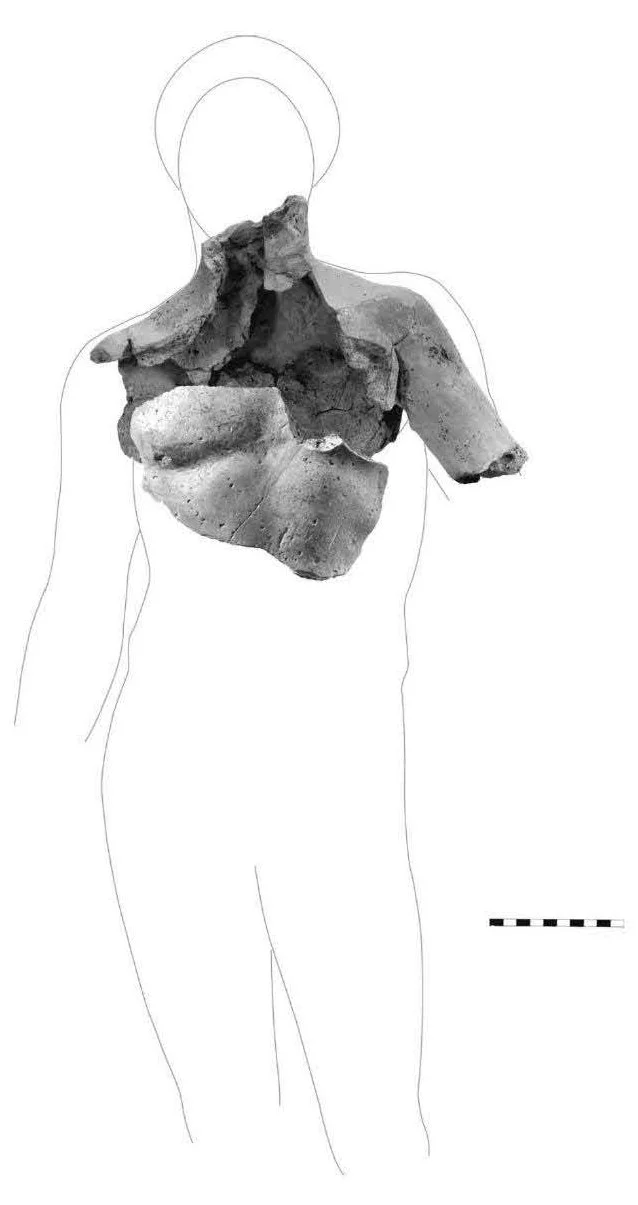
A depiction of a partial statue of a nude male from the sanctuary
Bookidis (2009) Nude Male (SF-64-13) over outline of Piraeus Youth.
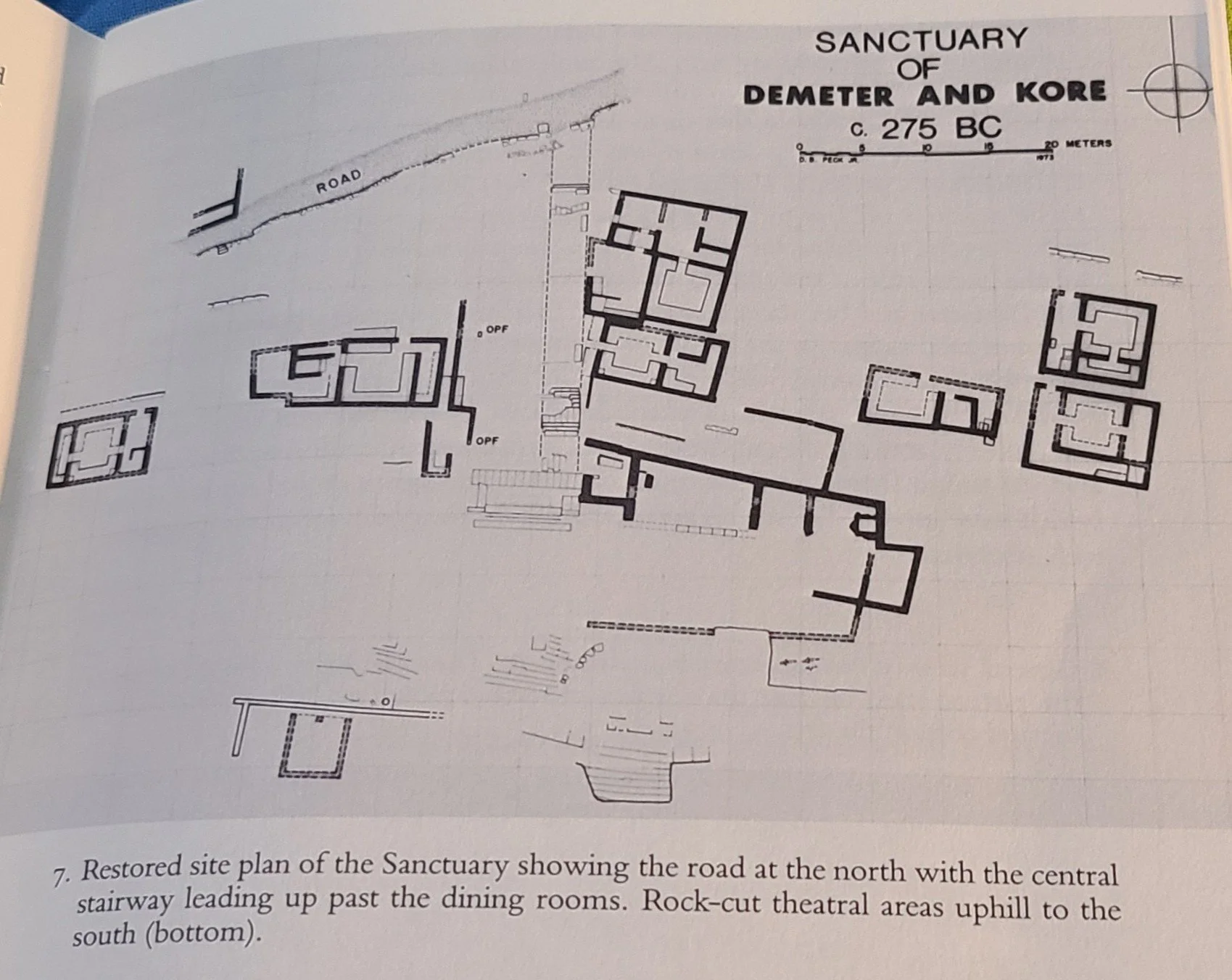
Site Plan - Figure 7, Stroud & Bookidis (1987) p. 9
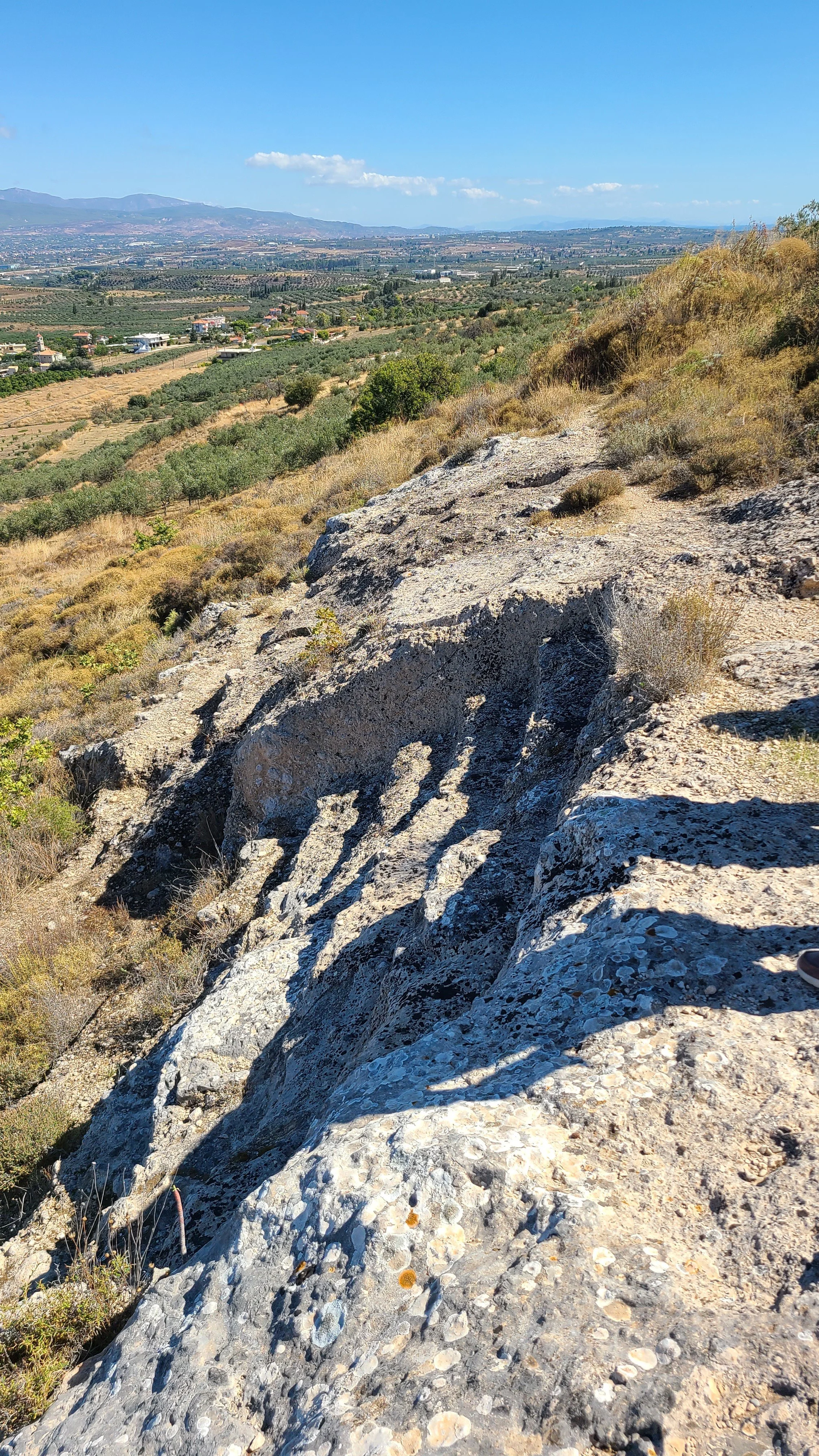
Following are what we saw in October 2025.
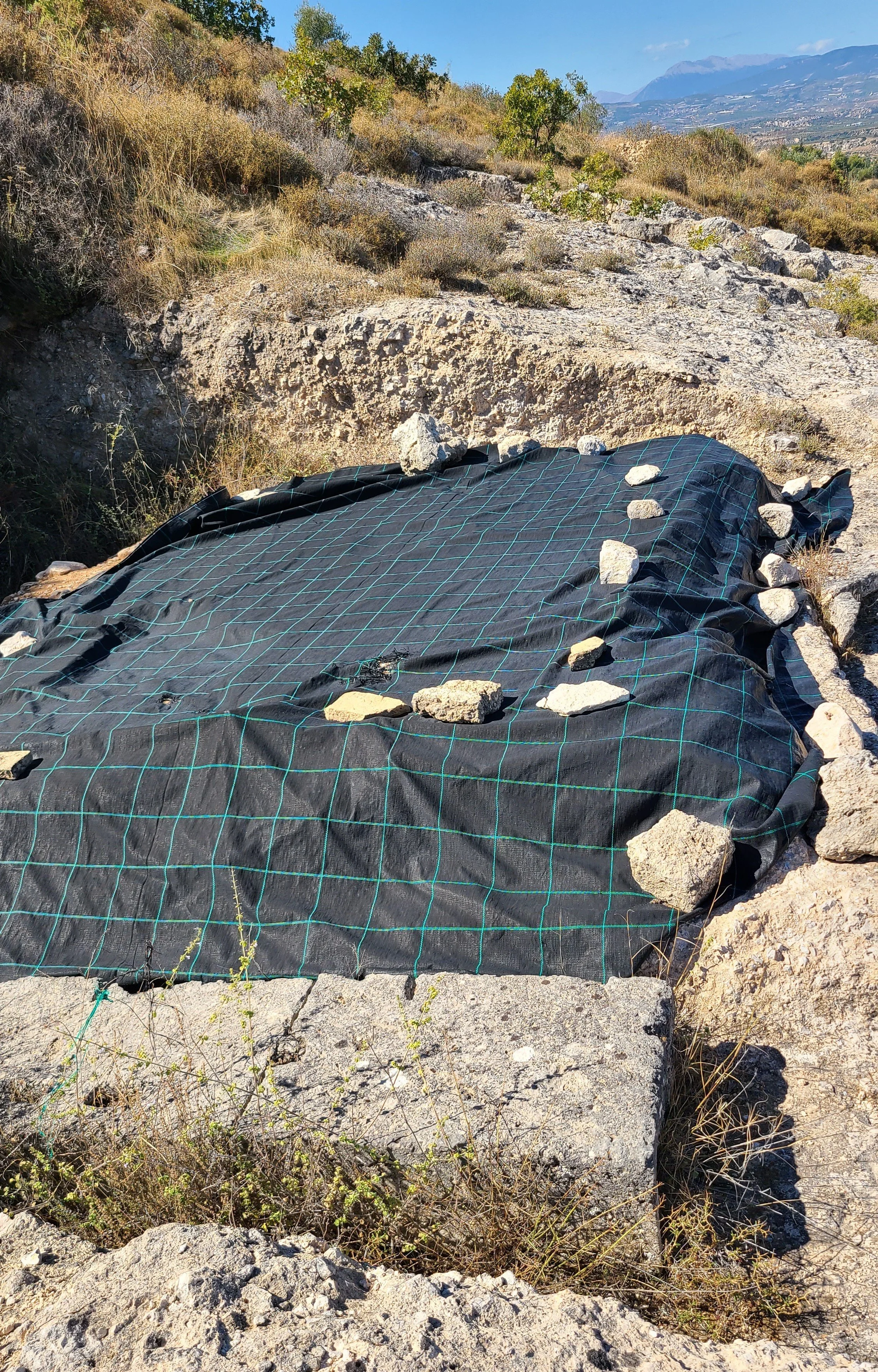
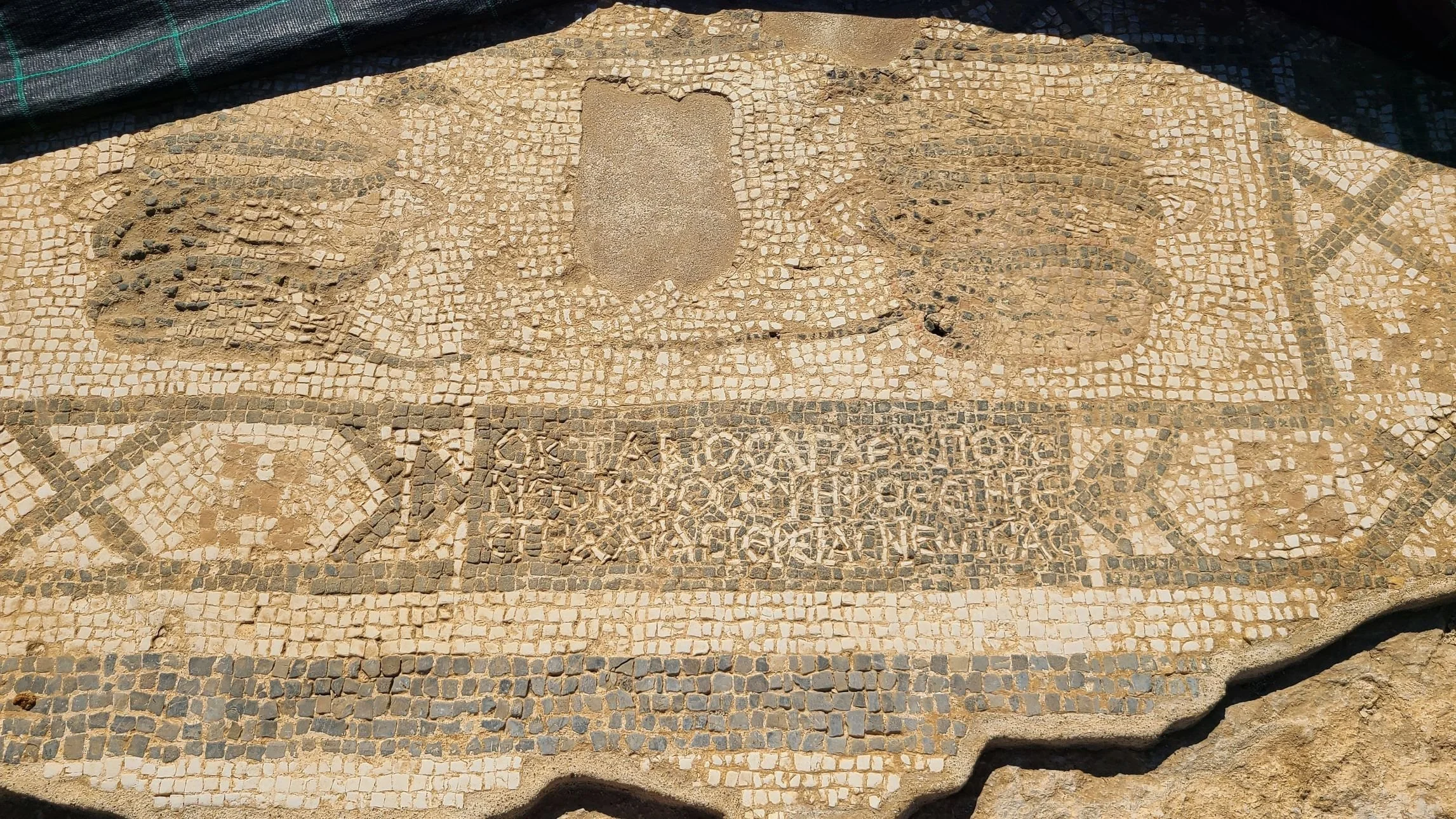
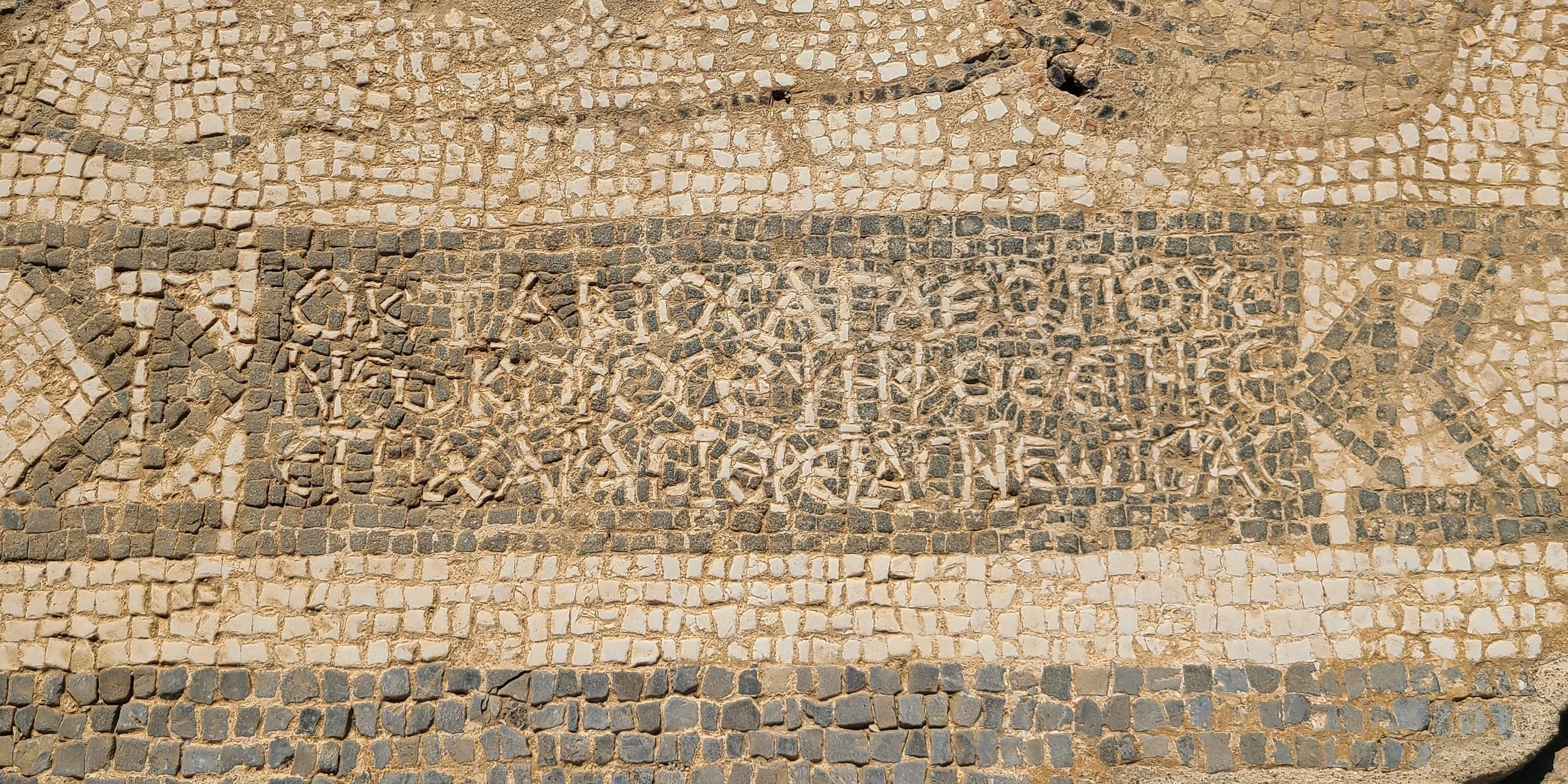
The translation of the inscription by Stroud [4] of the Late 2nd-Early 3rd century AD mosaic follows:
“Ὀκτάβιος Ἀγαθόπους
νεωκόρος ἐψηφοθέτησε
ἐπὶ Χαρᾶς ἱερείας Νεωτέρας
Octavius Agathopous,
neokoros, had the mosaic installed
when Chara was priestess of Neotera.”
North of the temple (down the slope) are several rock-cut dining areas where participants in the religious rites ate.
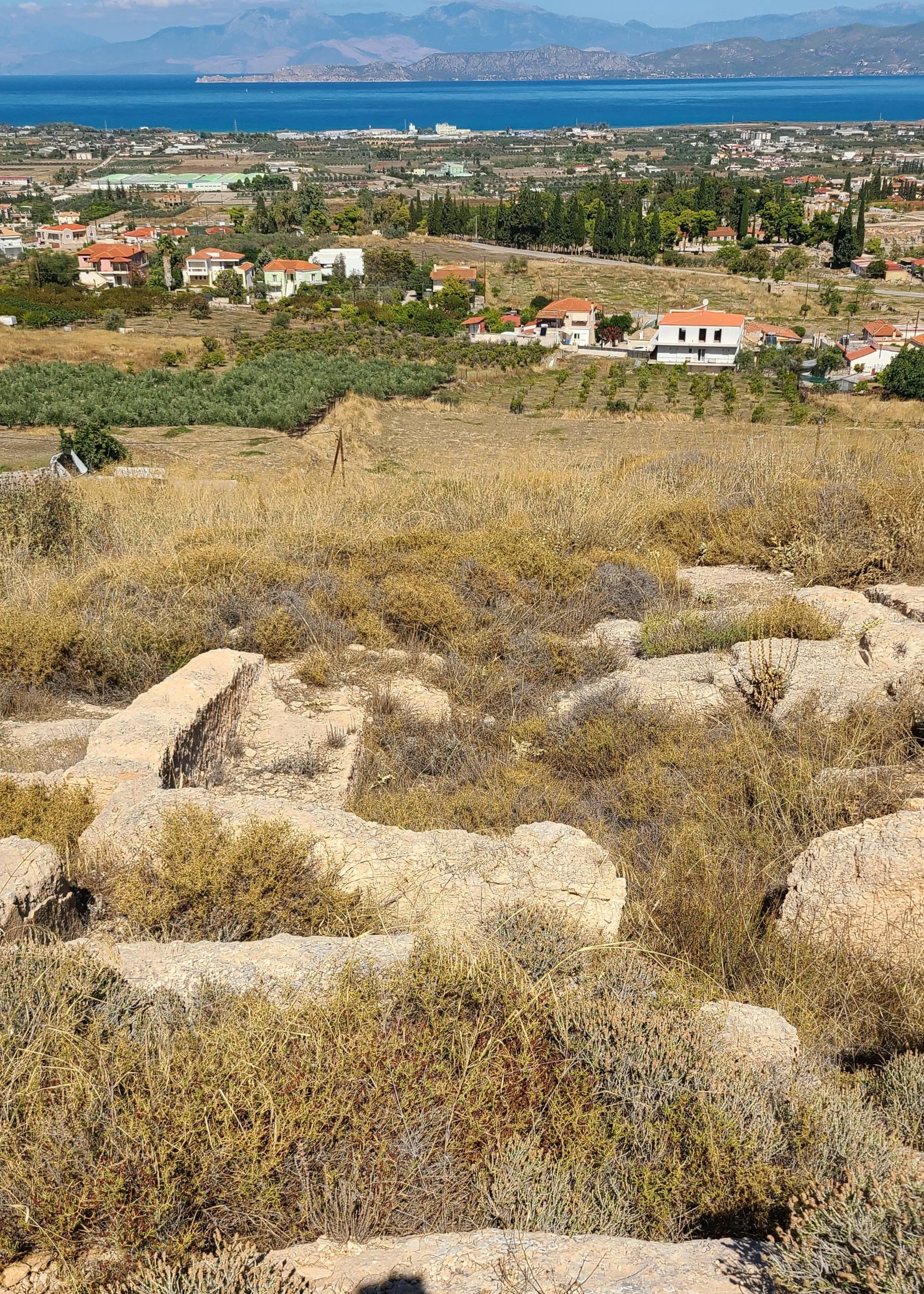
Remnants of some of the dining areas
This site is not open to the public. It would require some significant conservation efforts to get it in a state accessible to tourists, and there are other more impressive sites around that it would have to compete for attention. As an archaeologist I am grateful that Dr. Brown shared her insights and allowed us to view the ancient ruins.
[1] https://mq.academia.edu/AmeliaBrown
[2] Pausanias, Description of Greece with an English Translation by W.H.S. Jones, Litt.D., and H.A. Ormerod, M.A., in 4 Volumes. Cambridge, MA, Harvard University Press; London, William Heinemann Ltd. 1918.
[3] Bookidis, N. (2009) Large-Scale Terracottas and the Cult of Demeter and Kore in Corinth. In C. Prêtre (Ed.), Le donateur, l’offrande et la déesse. Liège: Presses universitaires de Liège. pp. 225-237.
[4] Stroud, R.S. (2013) The Sanctuary of Demeter and Kore: The Inscriptions. Corinth, 18(6), iii–184. http://www.jstor.org/stable/26494998
Bibliography:
Bookidis, N., & Pemberton, E. G. (2015) The Sanctuary of Demeter and Kore: The Greek Lamps and Offering Trays. Corinth, 18(7), iii–184.
Bookidis, N. (2010) The Sanctuary of Demeter and Kore: The Terracotta Sculpture. Corinth, 18(5), iii–319.
Bookidis, N. (2009) Large-Scale Terracottas and the Cult of Demeter and Kore in Corinth. In C. Prêtre (Ed.), Le donateur, l’offrande et la déesse. Liège: Presses universitaires de Liège. pp. 225-237.
Bookidis, N., Hansen, J., Snyder, L., & Goldberg, P. (1999) Dining in the Sanctuary of Demeter and Kore at Corinth. Hesperia: The Journal of the American School of Classical Studies at Athens, 68(1), 1–54.
Bookidis, N., & Stroud, R. S. (1997) The Sanctuary of Demeter and Kore: Topography and Architecture. Corinth, 18(3), iii–510.
Bookidis, N., & Fisher, J. E. (1974). Sanctuary of Demeter and Kore on Acrocorinth: Preliminary Report V: 1971-1973. Hesperia: The Journal of the American School of Classical Studies at Athens, 43(3), 267–307.
Bookidis, N., & Fisher, J. E. (1972). The Sanctuary of Demeter and Kore on Acrocorinth Preliminary Report IV: 1969-1970. Hesperia: The Journal of the American School of Classical Studies at Athens, 41(3), 283–331.
Bookidis, N. (1969) The Sanctuary of Demeter and Kore on Acrocorinth: Preliminary Report III: 1968. Hesperia, XXXVIII, 3. pp. 297-310.
Brumfield, A. (1997) Cakes in the Liknon; Votives from the Sanctuary of Demeter and Kore on Acrocorinth. Hesperia: The Journal of the American School of Classical Studies at Athens, Vol. 66, No. 1 (Jan. - Mar., 1997), pp. 147-172.
DeMaris, R. E. (1995). Demeter in Roman Corinth: Local Development in a Mediterranean Religion. Numen, 42(2), 105–117.
Merker, G. S. (2000) The Sanctuary of Demeter and Kore: Terracotta Figurines of the Classical, Hellenistic, and Roman Periods. Corinth, 18(4), iii–394.
Pemberton, E. G., Slane, K. W., & Williams, C. K. (1989) The Sanctuary of Demeter and Kore: The Greek Pottery. Corinth, 18(1), iii–234.
Slane, K.W. (2008) The End of the Sanctuary of Demeter and Kore on Acrocorinth. Hesperia: The Journal of the American School of Classical Studies at Athens,Vol. 77 (2008), pp. 465–496.
Slane, K. W. (1990) The Sanctuary of Demeter and Kore: The Roman Pottery and Lamps. Corinth, 18(2), iii–160.
Stroud, R.S. (2013) The Sanctuary of Demeter and Kore: The Inscriptions. Corinth, 18(6), iii–184.
Stroud, R.S. and Bookidis, N. (1987) Demeter and Persephone in Ancient Corinth. ASCSA.
Stroud, R. S. (1968) The Sanctuary of Demeter and Kore on Acrocorinth: Preliminary Report II: 1964-1965. Hesperia: The Journal of the American School of Classical Studies at Athens, 37(3), 299–330.
Stroud, R.S. (1965) The Sanctuary of Demeter and Kore on Acrocorinth: Preliminary Report I: 1961-1962. The Journal of the American School of Classical Studies at Athens, vol. 34, no. 1, pp. 1–24.
ASCSA. Corinth Monument: Acrocorinth Sanctuary of Demeter and Kore. Artifact images - https://corinth.ascsa.net/id/corinth/monument/acrocorinth%20sanctuary%20of%20demeter%20and%20kore